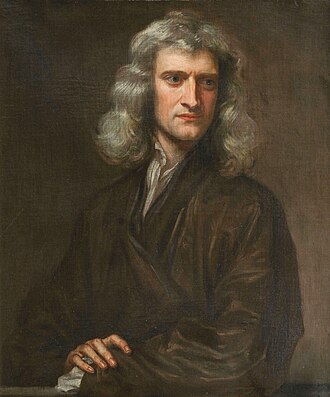
Sir Isaac Newton was an English polymath who was a mathematician, physicist, astronomer, alchemist, theologian, author and inventor. He was a key figure in the Scientific Revolution and the Enlightenment that followed. His book Philosophiæ Naturalis Principia Mathematica, first published in 1687, achieved the first great unification in physics and established classical mechanics. Newton also made seminal contributions to optics, and shares credit with the German mathematician Gottfried Wilhelm Leibniz for formulating infinitesimal calculus, although he developed calculus years before Leibniz. Newton contributed to and refined the scientific method, and his work is considered the most influential in bringing forth modern science.Wikipedia →
Works
De analysi per aequationes numero terminorum infinitas
On the Analysis by Equations with an Infinite Number of Terms
Neo-Latin · written 1669 and circulated privatelyNonfiction / Essays / Treatise
1 translation
De motu corporum in gyrum
Of the Motion of Bodies in Orbit
Neo-Latin · 1684Nonfiction / Essays / Treatise
1 translation
2 editions
De mundi systemate
On the System of the World
Neo-Latin · 1687Nonfiction / Essays / Treatise
1 translation
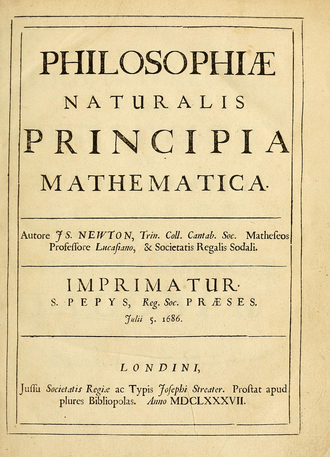
Philosophiæ Naturalis Principia Mathematica
Mathematical Principles of Natural Philosophy
Neo-Latin · 1687Nonfiction / Essays / Treatise
1 translation
1 edition
De Quadratura Curvarum
On the Quadrature of Curves
Neo-Latin · 1704Nonfiction / Essays / Treatise
1 translation

Arithmetica Universalis
Arithmetica Universalis
Neo-Latin · 1707Nonfiction / Essays / Treatise
1 translation

De Methodis Serierum et Fluxionum
Method of Fluxions and Infinite Series
Neo-Latin · 1742Nonfiction / Essays / Treatise
1 translation