Demosthenes
Δημοσθένης
Dēmosthénēs
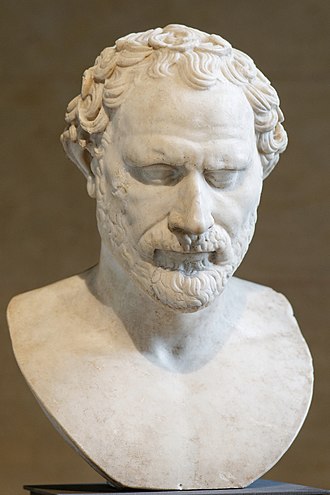
Demosthenes was a Greek statesman and orator in ancient Athens. His orations constitute a significant expression of contemporary Athenian intellectual prowess and provide insight into the politics and culture of ancient Greece during the 4th century BC. Demosthenes learned rhetoric by studying the speeches of previous great orators. He delivered his first judicial speeches at the age of 20, in which he successfully argued that he should gain from his guardians what was left of his inheritance. For a time, Demosthenes made his living as a professional speechwriter (logographer) and a lawyer, writing speeches for use in private legal suits.Wikipedia →
Works
δημηγορία
Political Speeches
παρρησίαι
Private Speeches
Ολυνθιακοί
Olynthiacs
Περὶ τῆς παραπρεσβείας
On the False Embassy
φιλιππικοί
Philipics (Against Philip of Macedon)
Ἐπιτάφιος Λόγος
Funeral Oration
Ἐρωτικός
Erotic Essay
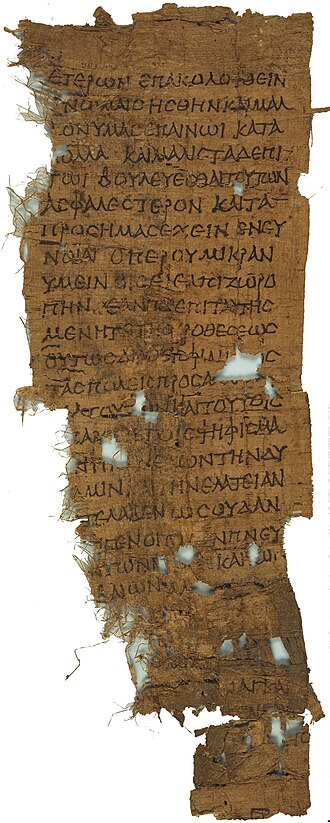
Ὑπὲρ Κτησιφῶντος περὶ τοῦ Στεφάνου
On the Crown
επιστολές
Letters
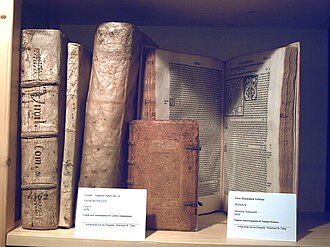
προοιμα δημηγορικά
Exordia (Prologues)
Short Works (9)
“Against Meidias” [“Κατὰ Μειδίου”].Speech.· -361.
"Against Meidias" is one of the most famous judicial orations of the prominent Athenian statesman and orator Demosthenes.
“Against Androtion” [“Κατὰ Ἀνδροτίωνος”].Speech.· -355.
"Against Androtion" was a speech composed by Demosthenes in which he accused Androtion of making an illegal proposal. This was the first surviving speech of Demosthenes composed on public charges.
“Against Leptines” [“Περὶ τῆς Ἀτελείας πρὸς Λεπτίνην”].Speech.· -355.
"Against Leptines" was a speech given by Demosthenes in which he called for the repeal of a law sponsored by Leptines, which denied anyone a special exemption from paying public charges (leitourgiai). Leptines had proposed the law around the years 355–54 BC. Although the name of the speech highlights Leptines, the content focuses on the unconstitutional nature of the law, rather than the fact that Leptines was the one who proposed it. During the time of the speech, it was understood that enough time had passed in which Leptines was no longer in the legal limit to be held accountable for the passing of the law. For that reason, Leptines was not personally attacked in the speech. Rather, the speech exhibits peaceful, stylistic choices that were unique for the time because of the lack of personal attacks against Leptines. Though Demosthenes wrote the speech for Ctesippus, the son of Chabrias, he delivered it himself. It is thus the first speech which Demosthenes delivered in a public case.
“Against Timocrates” [“κατὰ Τιμοκράτους”].Speech.· -353.
"Against Timocrates" was a speech given by Demosthenes in Athens in which he accused Timocrates of proposing an illegal decree. The speech provides our best evidence about the use of imprisonment as a punishment in Classical Athens.
“First Philippic” [“Φιλιππικός Α”].Speech.· -351.
The "First Philippic" was delivered by the Athenian statesman and orator Demosthenes between 351–350 BC. It constitutes the first speech of the prominent politician against Philip II of Macedon. A philippic refers to a type of speech that is negative in tone and one that is comparable to a rant or a tirade.